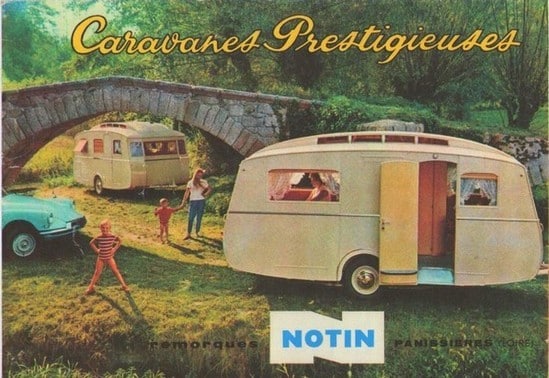
Motorhome manufacturer NOTIN will celebrate its 100th anniversary in 2021. This brand, based in Panissières in the Loire region, has been developing caravans for almost 100 years, and now exclusively motorhomes, which are associated with a certain idea of luxury.
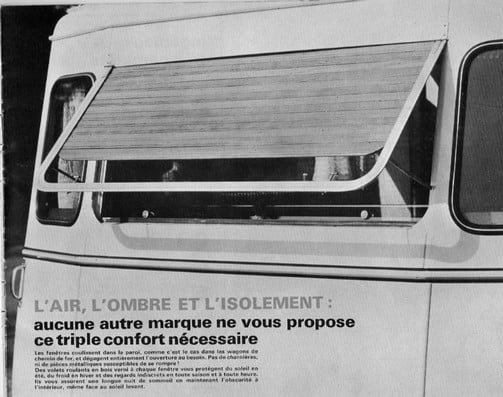
Some may remember these caravans, long recognizable by their wooden skylights and shutters. While materials and equipment have evolved, optional shutters are still available on Notin motorhomes, as is genuine woodwork assembled using the mortise-and-tenon system.
The origins of camping trailers
But let’s go back to Notin’s origins. From 1921 onwards, Francis Notin built fairground trailers, first animal-drawn, then, from 1928 onwards, automobile-drawn with his brother Joseph. In 1933, the Notin brothers created a touring caravan at the request of a Nice lawyer. This model differs from the caravan in that it has a side door instead of a rear door, and skylights to bring in light and fresh air. The windows drop down into the walls. In 1934, Joseph Notin bought the workshop from his brother and devoted himself to camping trailers. He was the first manufacturer to exhibit at the Paris Fair in 1935.
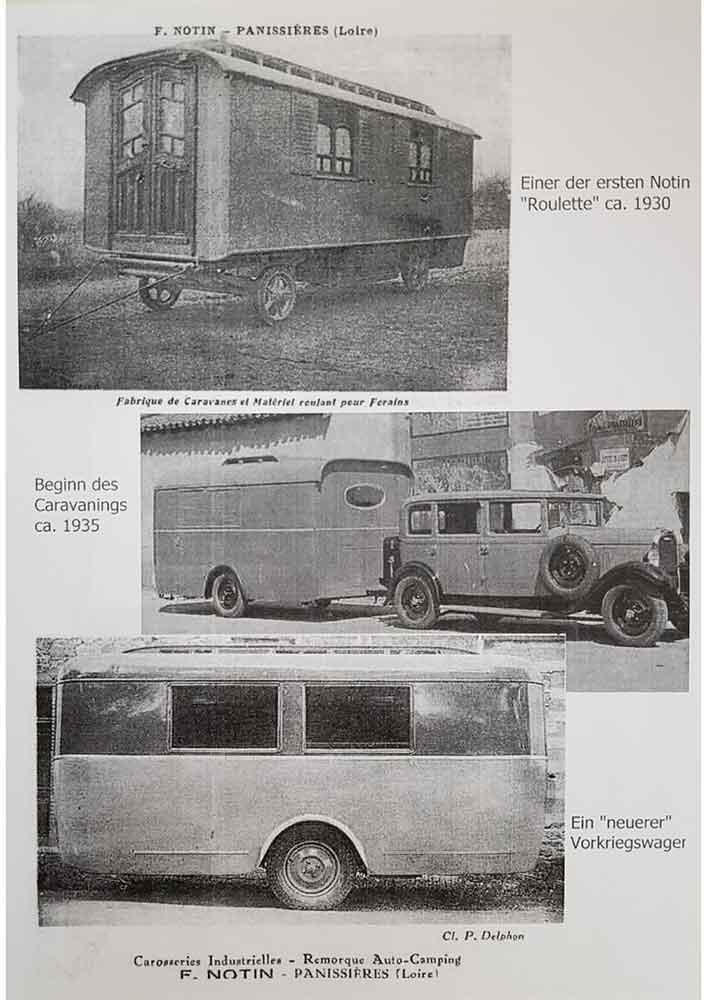
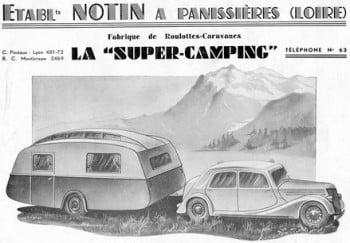
With the outbreak of the Second World War, production was reoriented, as was the case for many factories. The time was no longer ripe for tourism, and the brand responded to government orders to build caravans for public works, radiology, broadcasting, agricultural trailers and gas generators. After the war, tourism resumed, but was still reserved for a certain elite.
The 1950s, 60s and 70s: the popularization of camping vacations
In the 50’s, 60’s and 70’s, numerous models were produced, ranging from 3 meters to 7 meters. Notin even produced double-axle caravans. Notin caravans are available in two ranges, a light one with aluminum shutters and optional equipment, and a traditional one with fully-equipped wooden shutters. Above a certain size or as an option, they often feature a second door for the toilet, whose walls are lined with Panolac. Colors vary according to the era and the owner’s taste: pink, blue, black or orange. Various woods are available: Oregon pine, bird’s-eye maple, mahogany and Zebrano.
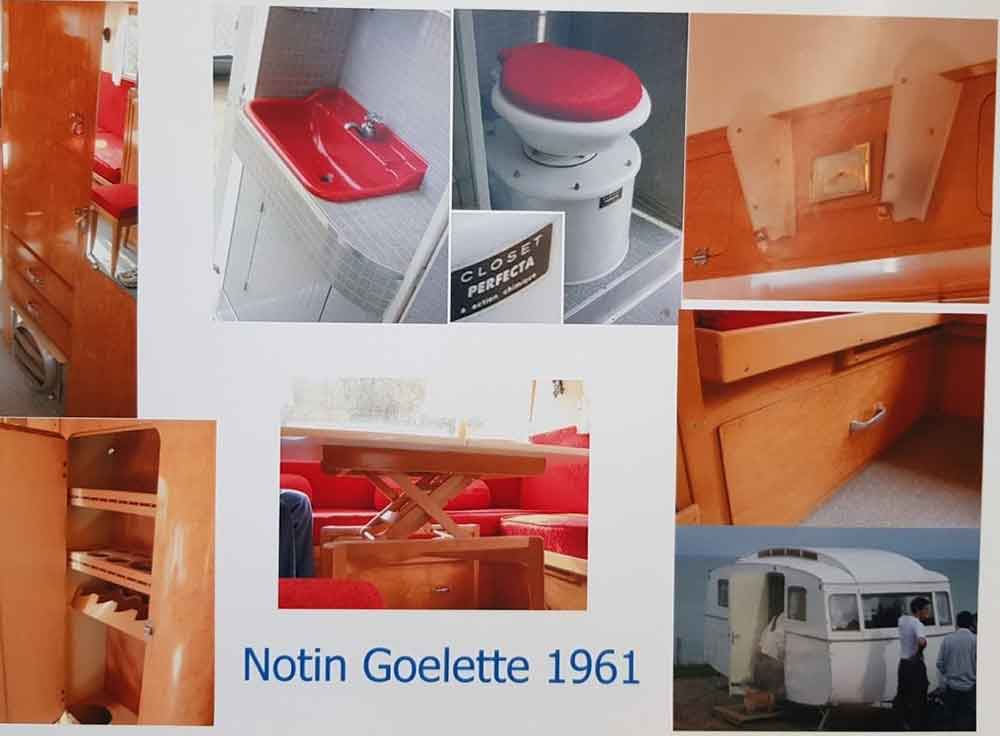
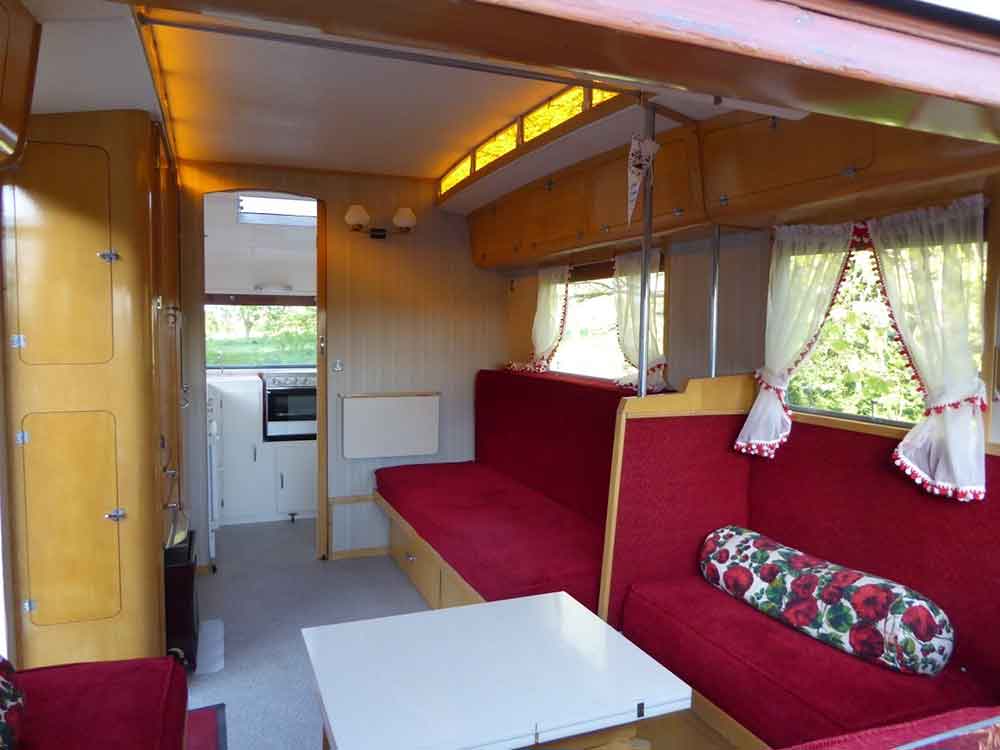
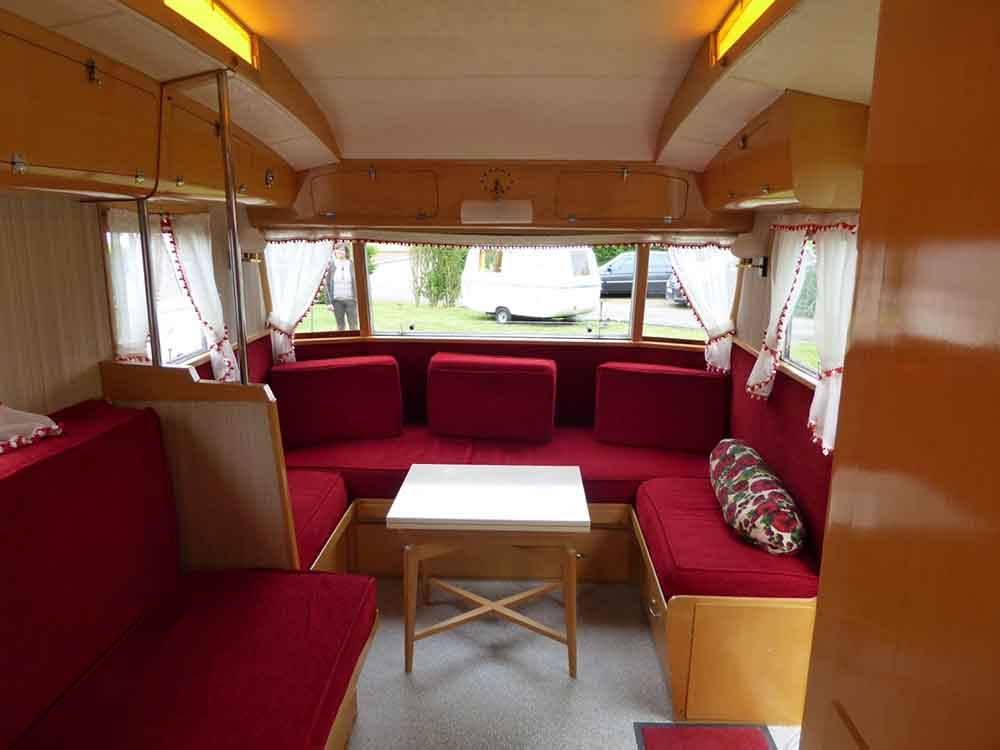
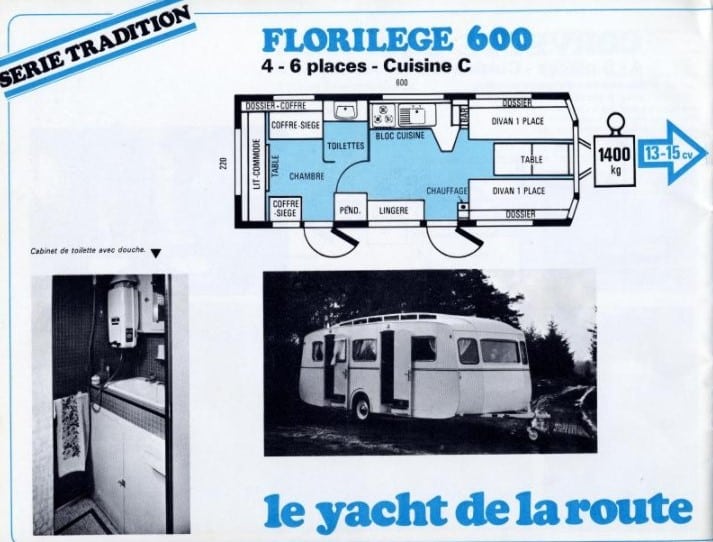
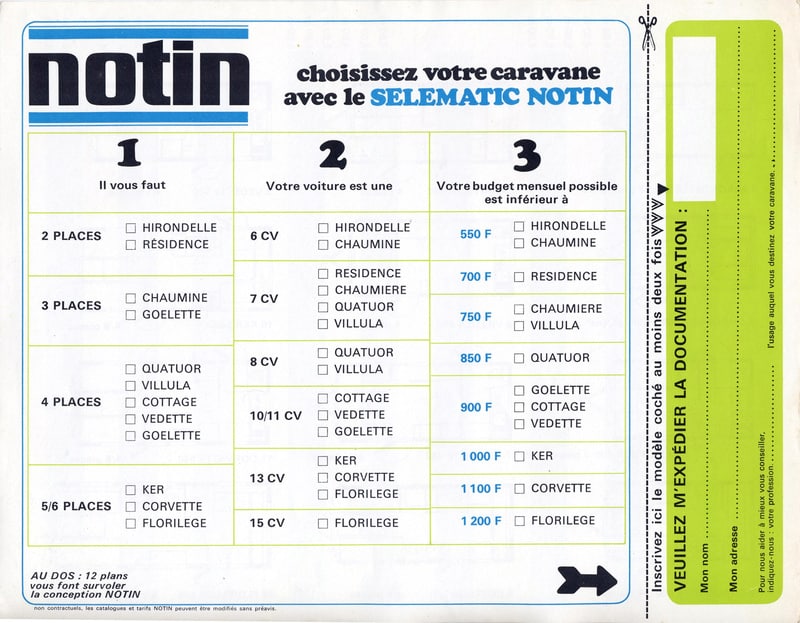
Shapes evolve little over the years, always marked by a certain roundness that diminishes over the years. There are also a few differences in the shape of the wheel arches and windows, first rounded, then squarer. Notins from the 1970s can be recognized by a thin brown stripe halfway up the body. They are called Benjamine (3m40), Chaumine (3m50- 610 Kg), Hirondelle (3m50- 610 Kg), Résidence (4m-900 Kg), Villula (4m50, 950 Kg), Vedette (5m40-1100 Kg), Ker (5m40-1300 kg), Corvette (5m40-1300 Kg) or Florilège (6m -1400Kg). They are also distinguished by the number of skylights, ranging from one to eight.
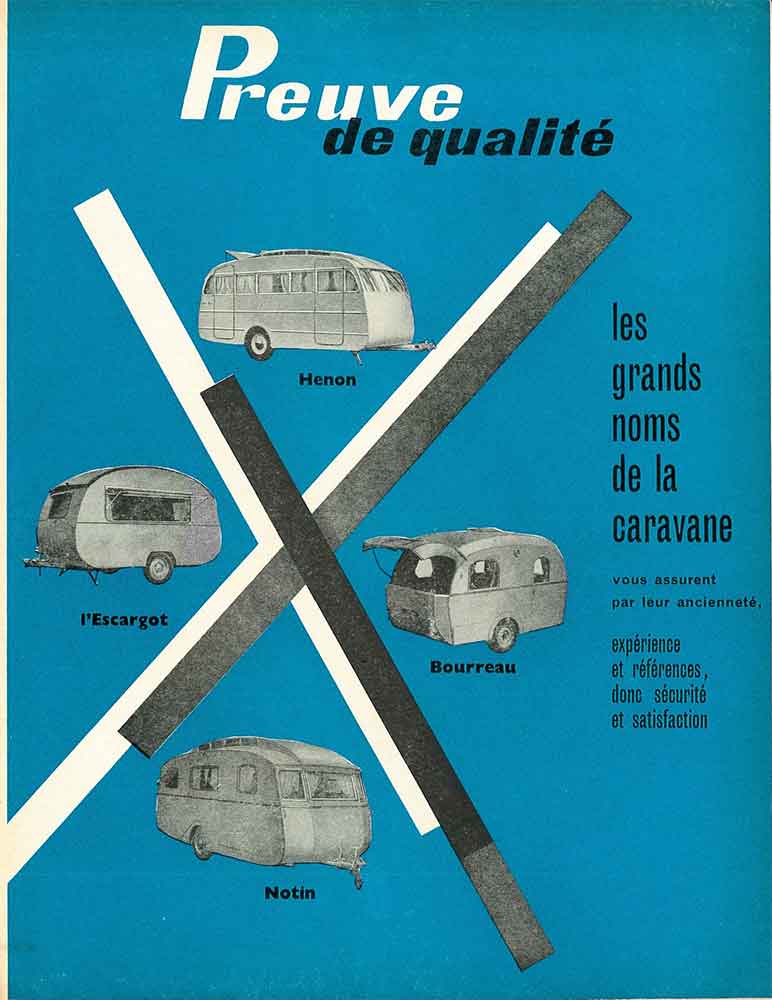
In reality, it’s sometimes difficult to make out which model to choose, due to the many possible variations in length/width and layout. They are made to measure. Production is artisanal in organization and number of units produced. According to 1975 figures from the Chambre Syndicale des Constructeurs de Caravanes, which only concerned registered caravans over 500 kg in GVW, Notin produced 24 caravans in 1975, compared with 15,000 for Digue and almost 8,000 for Sterckeman. Notin caravans remained models reserved for a certain bourgeoisie at a time when camping and, above all, caravanning had already become widely democratized.
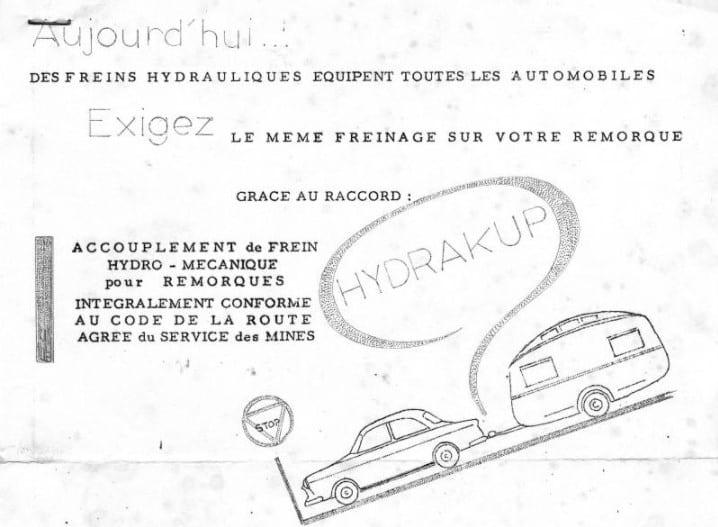
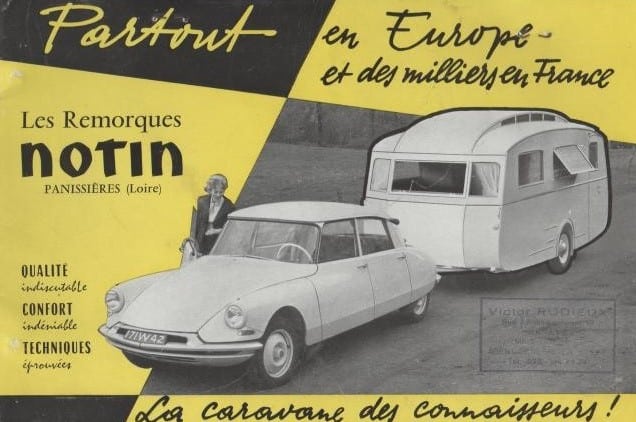
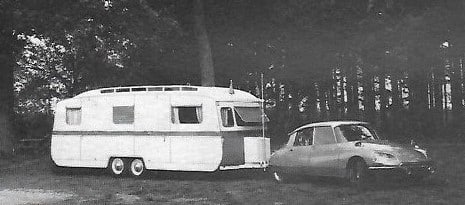
Most Notins required powerful American or Citroën DS tractor-trailers, as seen in the brand’s advertising. At the end of the 50s, Notins were equipped with Hydrakup brakes, for which the brand was the exclusive importer.
Attempts to democratize the brand
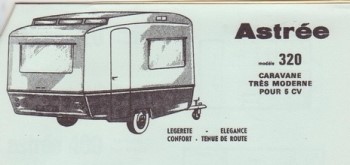
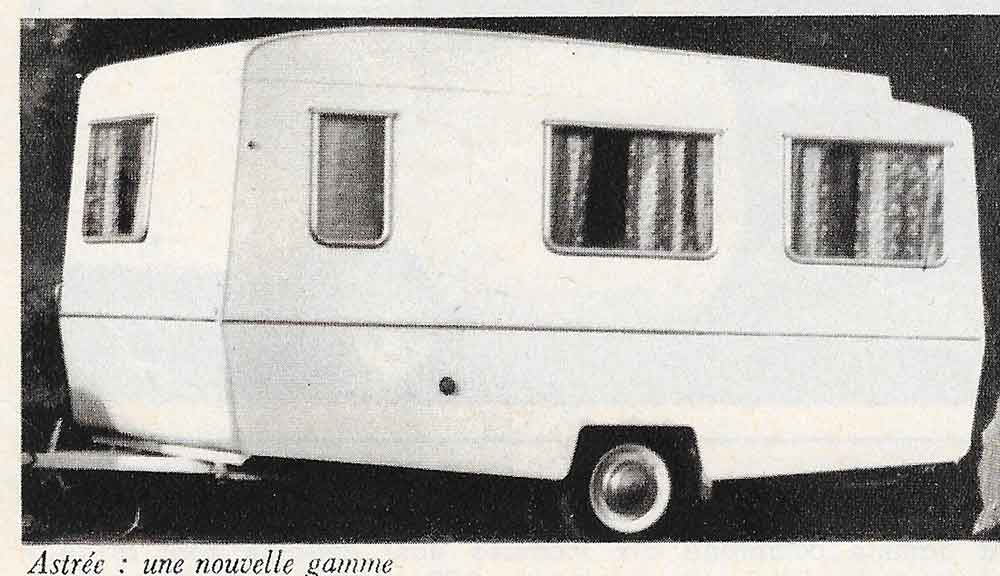
The brand repeatedly sought to produce cheaper caravans. In 1966, a new range was launched, the Astrée, comprising 3 models (3m20, 4m and 4m70).
1970 saw the launch of a new “Caravelle” range. This caravan, strangely cubic but retaining the skylights, was even offered in 2 or 4-seater versions, 2 to 3 times less expensive than a classic Notin of the same size. According to an advertisement, this is a Notin license.
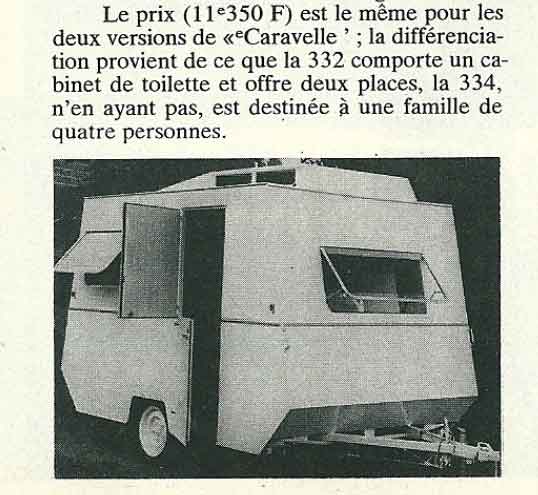
In the 1980s, it was the turn of the Notin 2000, but none of these attempts to “democratize” the brand found its audience. In fact, the word “democratize” is a little strong. The idea was to offer a more modern caravan. A 4m Notin 2000 costs 42,000 francs, while a Notin Tradition of the same size costs 10,000 euros more. It’s certainly more modern when compared to the old range, but it’s also lighter, with a GVW of 1,000 kg. The Adria brand, whose sales were very strong at the time, costs around 15,000 euros for a model of the same size. Of course, these models are not of the same standard. Notin is top-of-the-range and will remain so. This is certainly what has enabled it to survive to the present day.
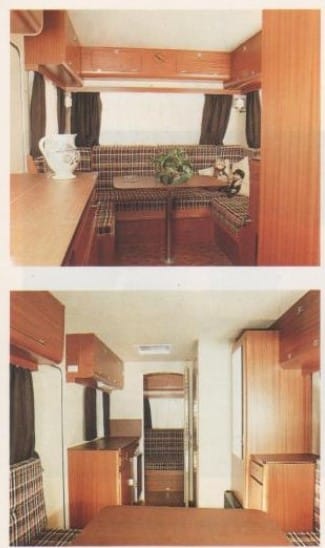
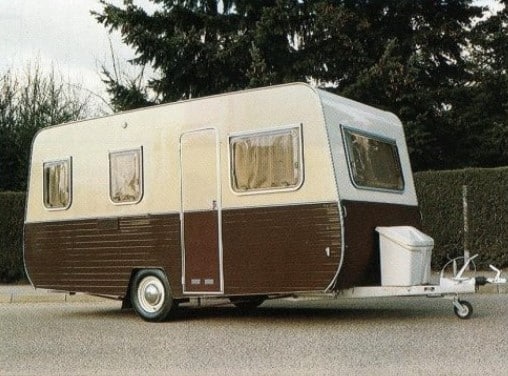
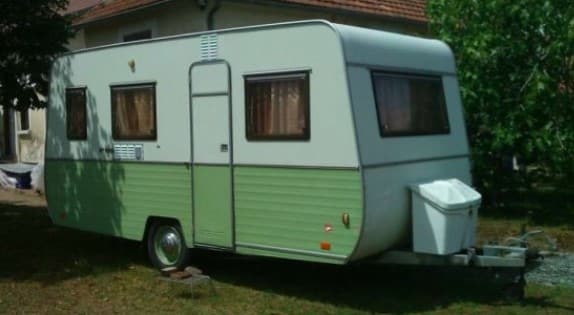
The brand’s founder died in 1959, aged 56. The brand remained in the family until 1969, when Madame Coursin-Notin, his daughter, left the company. By 1970, every second Notin is a motor home. The factory was handed over to Pierre Bruan in 1978, and since 1990 has produced only motorhomes.
From the Living Car to the Camping-Car Notin
These days, you’ll see them on the roads, integral models of often impressive proportions. Their equipment is also worthy of the best luxury apartments. But when did their precursors appear?
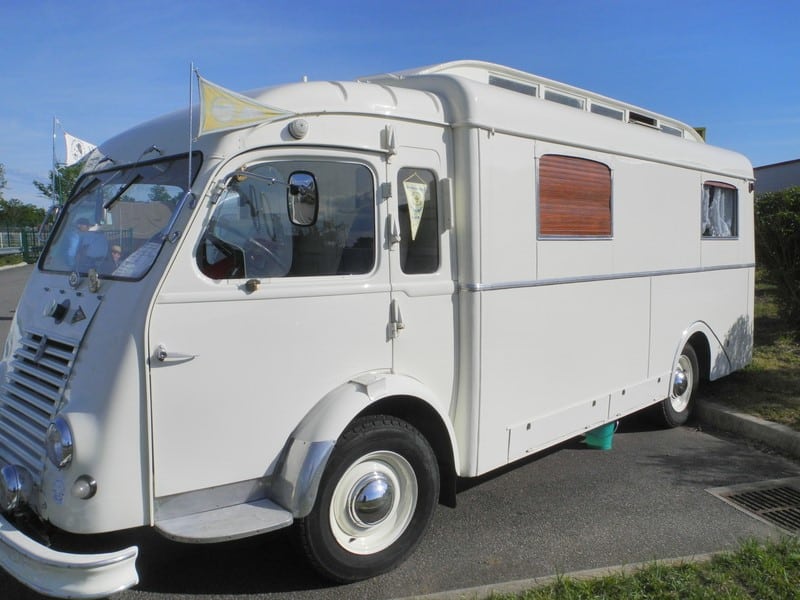
In 1951, the specialized press mentioned two motorhomes, a Notin and Pierre Digue’s Passe-partout, both built on Renault 1000 kg chassis. The 14 hp 2.3 l petrol engine develops 46 bhp at 2,800 rpm, and is served by a 3-speed gearbox. The bodywork is always the work of the fitter, who retains only the driver’s cab and Renault chassis, with flat or skylight roof, blacked-out windows and all the comforts found in Notin caravans.
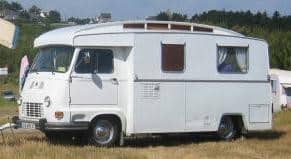
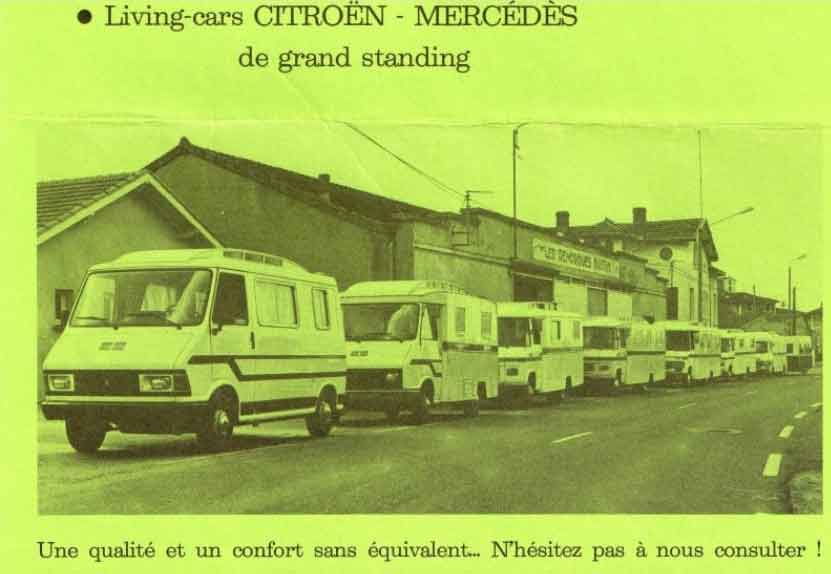
In the ’70s, more carriers were available, chosen according to cell size and weight. The lightest on Ford Transit, Peugeot J7 and Citroën C35. The lightest and heaviest on the Mercédès 408, 508 and Hanomag. There were also a few cells on Renault Estafette, but the low power of this vehicle was not suited to the weight to be carried.
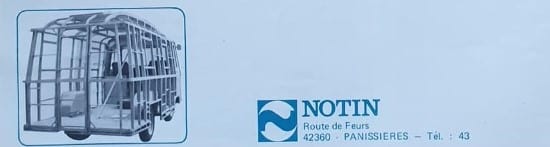
It’s worth noting that, in the past, we didn’t call a cell on a carrier a motorhome, but a camping truck. This sounded like a utility vehicle, and didn’t suit the standing of the NOTINs, whose caravans were nicknamed “the yachts of the road”, as can be seen in several advertisements. The more chic “living-car” name was chosen by the brand after Mme Andrée Coursin-NOTIN.
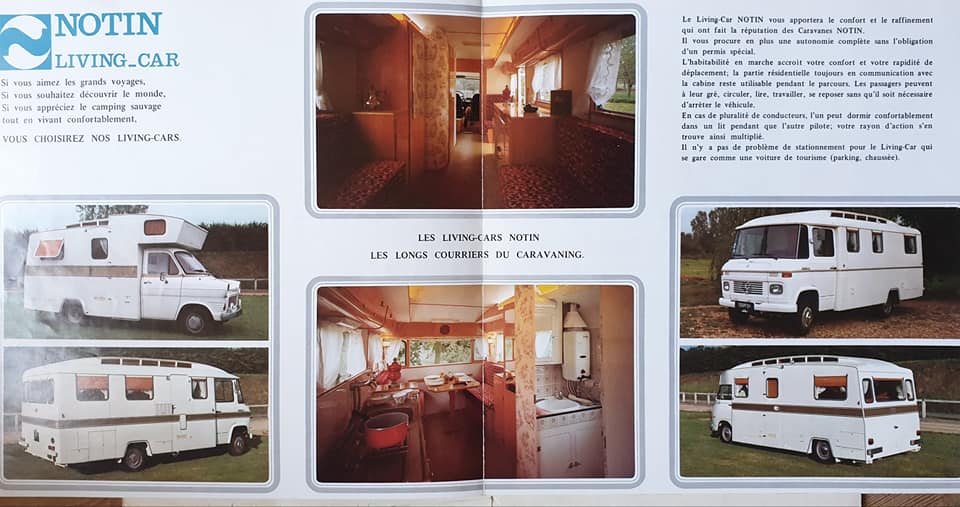
From a Notin advertising column, probably 1974:
The Notin Living-car brings you the comfort and refinement for which NOTIN caravans are renowned. What’s more, it gives you complete autonomy without the need for a special permit. On-the-road habitability enhances your comfort and speed of travel; the living area, always in communication with the cabin, remains usable during the journey. Passengers can move around, read, work or rest as they please, without having to stop the vehicle. And if there are several drivers, one can sleep comfortably in a bed while the other pilots, multiplying your range of action. There are no parking problems for the Living-car, which can be parked in the same way as a passenger car (parking lot, roadway).
In 2005, for the brand’s 90th anniversary, the company has 50 employees and produces 80 to 110 motorhomes a year. The brand will be 100 years old next year, and the success story continues, thanks to inventive entrepreneurs who never forget the past.
Author:
Christophe Leroy, RCCF member.
Sources:
Bruno Leroux and Maurice Girard, “Caravanes de chez nous”, Ed. MDM, 1998
Sylvie and Franck Méneret, “Caravanes de France et d’ailleurs 1920-1960”, E-T-A-I
Site Digue-Dingue-Dong
https://michelcaravanier.skyrock.com/
Magazine le Caravaning, sept 1966, N°132.
Facebook page Documentation caravanes anciennes

Author: We Love Camping
C'est parce que nous aimons le camping traditionnel que nous avons pensé à ce site. Parce que nous regrettons parfois que le mobile-home occupe désormais tant de place sur les campings, nous avons voulu mettre en avant les terrains où les tentes, les caravanes et les camping-cars restent majoritaire. Et offrir à tout ceux qui partagent notre amour de la vie en plein air, un site avec des idées de voyages, des conseils techniques et surtout un choix de campings où il fait bon venir poser sa caravane ou planter sa tente.
Leave a Reply